This post is going to be a long one…
After competing at the Cheerleading Worlds in Orlando, I wanted to take advantage of being in Florida and see all their National Parks. The Monday after worlds, Felix and I drove down to Miami to visit our first park: Everglades. The park is decently big and has a few distinct sections. Upon our arrival in the afternoon, we visited the northern section of the park, called Shark Valley, though (disappointingly) there are no sharks–it’s all grassy wetlands. Shark Valley features a 15-mile-long paved loop path which you can walk, bike, or take a tram tour on–we opted to bike.

The path runs next to a channel that’s teaming with wildlife. At first, we thought the bike ride would be pretty boring because the scenery doesn’t change much along the path, but we quickly started spotting alligators and that made a fun activity out of it. The first gator we spotted was so exciting and we stopped to take a picture of it. I told myself I’d keep count of the gators by taking pictures of each one I saw…I gave up on that after six. None of them were huge, they were only about six feet long. We also saw a ton of fish in river, along with birds and a few turtles.


We rented the bikes and had to return them promptly at 5pm so we only biked four miles and then turned around. I stopped counting gators on the way back because we weren’t sure which ones were new and which we’d already seen. One exciting spotting was when we saw two gator right next to each other and one had its mouth open.

There was a clear river on one side of the road and the other side was dryer but had water in some areas. I discovered that there were a bunch of pipes crossing under the road (culverts) that allowed water and animals to cross. The pipes were pretty big and we theorized that they were made that big to be able to fit the gators. Later that theory was proven true because I saw a gator coming out of one of the pipes (it moved out before I could get a picture). As a water conveyance engineer, I love the idea of gator culverts. We probably saw 20+ gators in the two hours we were in the park. Near the visitor center, there was an active alligator nest and we got to see a bunch of babies swimming around.

After returning our bikes we walked a short boardwalk path and then went to our hotel. That was all for Shark Valley. The next day we went to the southern portion of Everglades. There’s a long road through the park that takes you from Homestead (a town just south of Miami) all the way to the southern tip of Florida. Along the road, there are a number of spots where you can stop and do short boardwalk hikes. The first one we did was called the Pa-hay-okee overlook and it took us to an observation platform where we could see out over the wetlands. This was not a particularly impressive view.

Next we went on the Mahogany Hammock trail which took us onto one of the tree islands. They’re called “hammocks” and not “islands” because there’s no real land under them. These islands are created from buildups of plants and trees living and dying on top of each other. We didn’t linger too long on these trails because they were pretty buggy–surprisingly no mosquitos but lots of bugs buzzing around our heads.

Finally we drove far enough to reach the Flamingo Visitor Center where there’s a marina. At this point, the everglades open up into the Florida Bay and there are a ton of mangroves around. A bunch of manatees were hanging out around the docks, munching on sea grass.

We took a guided boat tour which took us through mangroves and out into the bay. This tour didn’t end up being very interesting because the only wildlife we saw were birds. The tour guide told us a lot about the plants and how there are three different types of mangroves: the red mangroves, which have long roots that can live in salt water, the black mangroves which have tubes that rise above the water to be able to get oxygen, and the white mangroves, which can’t live in saltwater. Near the visitor center, we saw a forest of dead trees. The tour guide explained that those there black mangroves and they died during a hurricane when the high waters put their roots underwater for too long. I thought it was funny for trees to be able to drown.

This area is the only place in the world where alligators and crocodiles live in the same habitat. I went on the boat tour hoping to see some crocs and we didn’t see any until the end when we were pulling back into the marina and then we saw like four at once. The crocodiles are scarier looking than the alligators because their teeth are more pronounced. One croc was nesting in the marina.

After the tour we headed back north and did another boardwalk trail. There was a trail through a pine forest that I wanted to do but it started raining pretty hard. We waited in the car for a bit to see if the rain would pass, but it didn’t, so we moved on. As we were heading out of the park, we got to an area where it wasn’t raining so we did one more hike: the Anhinga trail. I had skipped this one on the way in because I heard there were vultures in the parking lot that rip the rubber parts out of your car. We saw signs warning about the vultures but they weren’t there that day. This trail was another boardwalk that took us through some lily pad-filled ponds. Didn’t see any gators. The rain caught up with us while were were out so we got a bit wet.
The Everglades are an excellent national park for wildlife spotting. I thought I’d like the southern portion of the park more than the northern part, but the northern part was probably my favorite. We saw so much wildlife in such a short period. I thought the mangroves in the southern portion weren’t actually that interesting. My favorite part of the southern portion was the manatees.
The next day we were off to the next park: Biscayne. This park is just south of Miami and is mostly water so we booked a tour with Biscayne National Park Institute to take us out on the park. Felix and I boarded a motor boat with four other tourists and they took us out on the bay. Our tour guide explained that the bay is very shallow, only about 5 ft deep most places, and the land was originally owned by an oil tycoon who wanted to dredge a channel and make it a big port, but the area was declared a national monument to stop him. We saw a small group of dolphins on the way out and our guide explained that mothers like to teach their calves to hunt in the shallow water.
We reached an area where we anchored and snorkeled for an hour. I put my phone in a water proof case to try and get photos of the fish and coral, which was not very successful. The reefs had a decent amount of fish and I was pleased. The guide said it wasn’t an ideal day because there had been storms, and normally the water would have been clearer.


We stopped for lunch on an island that used to be owned by a rich guy. Felix and I took this opportunity to do a little acro and got a sick hand-to-hand picture.

Next we motored over to some mangroves to go paddle boarding and saw more dolphins on the way. The water in the mangroves was super clear and we could see a bunch of fish. I saw three stingrays and two nurse sharks! I definitely recommend wearing polarized sunglasses to make it easier to see into the water. At one point we stopped for a break and Felix and I did headstands on our paddle boards. The rest of the group thought was very impressive, given that many of them were struggling just to stand on their paddle boards.

We went through some tunnels in the mangroves where the trees created a canopy over us. In these areas you had to sit and it was hard to paddle. One method of getting through them is to put the paddles down and grab branches to pull yourself.

In one area I noted to Felix that there were a bunch of jellyfish on the bottom. He thought they were anemones but our guide confirmed that they were upside-down jellyfish. They look liked cauliflower.

Paddling through the mangroves was super fun, definitely my favorite of the activities. After paddle boarding we motored back to the shore. This tour was a great way to experience Biscayne and I recommend it.
Everglades and Biscayne are both right outside of Miami, but the final national park on my itinerary, Dry Tortugas, is located 70 miles off the coast of Key West, so this required some more driving. We spent the next day driving south through the keys and stopping at a few fun spots to break up the day. The first stop was a place called Robbie’s of Islamorada where we did tarpon feeding.

For a small fee you can go out onto a dock where there are tons a tarpon swimming around. Tarpon are big silver fish that are common around Florida. You dangle a fish above the water and the tarpon will jump out and open their huge mouths to grab the fish. The dock was also swarming with pelicans trying to steal the fish. You’re not supposed to feed the pelicans, and they make feeding the tarpon quite a challenge. Felix and I both got one successful tarpon jump. Felix’s hand went inside the fish’s mouth which he said was scary but not painful because the fish didn’t have any teeth.

I took a slow motion video to be able to get this picture.
The next stop was the Dolphin Research Center. This place had a bunch of dolphins (some rescues, some born at the center) living in ocean-side pen. First we watched a show where dolphins were doing tricks while a bunch of tourists were in the water interacting with them. We could’ve paid to do this as well but opted out (something about it feels too cheesy to me). There was one pretty cool trick where a person held onto the fins of two dolphins while they swam. We watched the show and then just hung out and watched some dolphins as they swam laps in their tank.

Next we watched a show about dolphin training and this was super cool because the trainer did it right in front of us. I’ll admit I’m not really sure if it’s ethical to keep animals as intelligent as dolphins in enclosures like this, but the trainer made me feel a bit better about it. She showed that the dolphins didn’t get fed after every trick. They got fed all their fish in the beginning, without having to do anything. They only got a whistle response for doing tricks correctly. We had noticed that the walls to the dolphins pens weren’t super high and we asked her why they didn’t just jump out and escape. She said it was probably two things: 1. jumping over obstacles isn’t a behavior dolphins would do in the wild so they probably never thought to do it and 2. their lives in the research center are really easy, they have easy food and their families are there, so they wouldn’t want to leave. She said once a dolphin did escape but he had jumped out, swam around, and then jumped back into a different pen with the females. This trainer obviously wouldn’t tell me that the dolphins were living miserable lives in the research center, but her explanations made me feel a bit better about the ethics of this operation.

And we saw the dolphins do jumps! At one point we got to give the dolphins instructions (which they didn’t understand super well but they tried). I didn’t have super high expectations for this activity but getting to see the training session up close made it super cool.

Our final stop in the keys was a turtle hospital. We got a tour of the facility where our guide explained that all species of sea turtles are endangered and the hospital rescues turtles that people report as needing help. There are a few common conditions they help turtles with. 1. Turtles who have eaten too much plastic and trash and it sticks in their stomach so they stop eating–the hospital gives them laxatives to pass the plastic. 2. There’s a common virus in turtles that, when triggered by stress or pollution, causes them to grow tumors. The hospital surgically removes the tumors and they were performing a surgery during our tour that we could watch. The tumors are pretty gross looking and I did not take pictures 3. Turtles that have been hit by motor boats. The hospital can help repair their shells, but a common issue when this happens is that the shells heal in a way that they form internal air bubbles that make the turtle float. They refer to this as bubble butt. The only thing the hospital can do to help with bubble butt is put weights on the turtles to try to even them out when they swim, but the weights can’t stay on permanently so a lot of turtles with this condition can’t ever be released. I learned that it’s illegal to keep a healthy, releasable sea turtle, so any sea turtle you see in an aquarium has some condition that makes it non-releasable.

After they taught us a bunch about the turtles, we got to walk around and see the turtles they had. Some were there temporarily for treatment and some were permanent residents. They had one big tank of permanent residents and it was mostly turtles with bubble butt where you could clearly see lumps in their shells and their irregular swimming. They were a little sad to look at.

The full grown turtles were 3-4 feet long. They also had some young ones that were very cute.

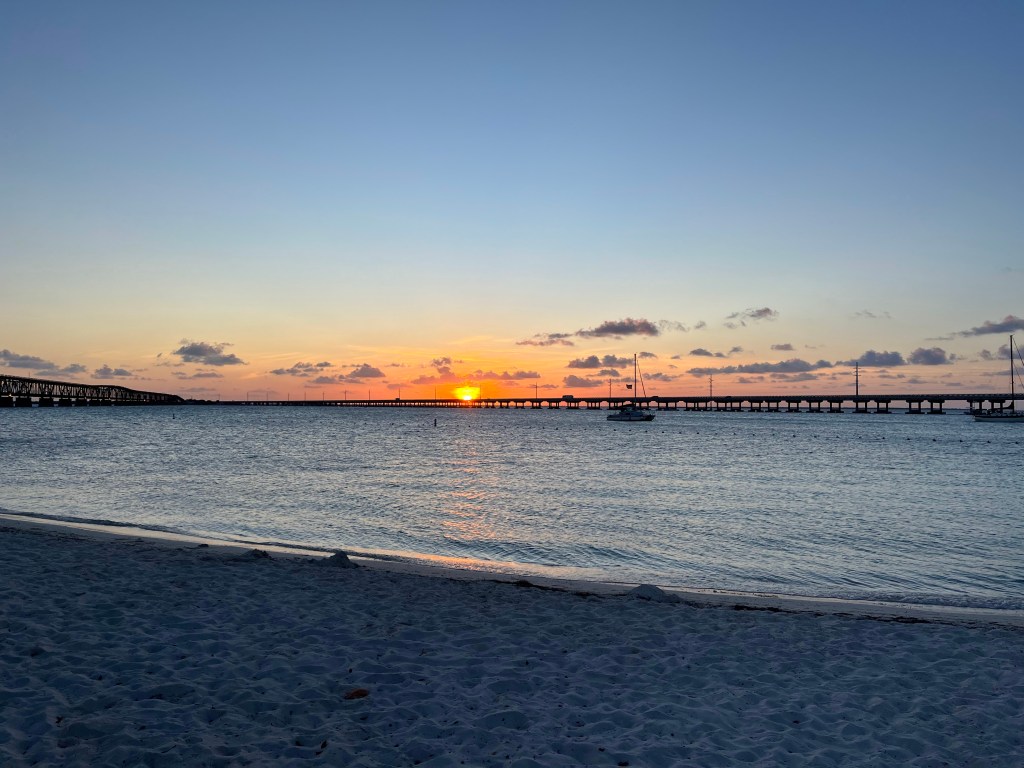
After the turtle hospital we drove to our motel, which was 40 minutes from key west. The motel was the most expensive place we stayed and still the cheapest thing we could find in the keys. We make a quick trip to a nearby park to watch the sunset.

As I mentioned, Dry Tortugas is 70 miles off Key West, so getting there is an endeavor. The way most people get there is via a 2.5 hour ferry ride. Unfortunately (or fortunately) the ferry was sold out when we were planning the trip. This left us with the cooler, more expensive option: a sea plane. We drove to the Key West airport to board our sea plane to Dry Tortugas. It was a small plane that held 10 passengers.

I didn’t realize going into it, but the sea plane ride was a very fun part of the trip. In the beginning, we were flying over shallow water where we could see sharks in the water. Then when we flew over deeper water, we saw tons of sea turtles. They must’ve all been about 4 feet long. We also flew over some shipwrecks and the pilot told us that one of the ships belonged to a famous treasure hunter who, after 16 years of searching, found a shipwreck in this area with like $500 million worth of treasure.

The plane ride was only about half an hour and then we arrived at the primary island in Dry Tortugas, which has a brick fort built on it. We only had about 2.5 hours on the island so we went snorkeling first since it was what I was most excited about. First we snorkeled in the southern half of the island because it was recommended for having calm waters. There were some metal pillars in the water that were the remnants of coaling docks and they had a ton of fish and coral growing on them. I once again tried to get pictures, to little success. The coral growing on the pillars was really cool – better than Biscayne. I saw angel fish, parrot fish, barracuda, and one tarpon.


At one point we saw a big stingray and he didn’t swim away from me so I got a good long look at him.

Unfortunately, a large reef area that was noted as having some of the best snorkeling was closed off for recovery. We then decided to head to the northern area which we were told was for experienced snorkelers because the water is rougher. I ended up being just fine. There were also coaling dock ruins in this area but they had way more fish than the ones on the south side of the island. There were a lot of big schools. There were almost no other people snorkeling this area because of the warning about rougher waters, which was nice. I loved seeing all the fish and this was probably my favorite part of the entire trip.


We spent the last half hour exploring the fort. Felix read that it’s the largest brick building in the western hemisphere. That fact doesn’t seen like it should be right because the fort isn’t THAT big but I guess it’s rare to build something out of ONLY brick. The fort was built in the 1820’s to protect trade in the Caribbean. It later was used as a prison during the civil war.


You can walk around the inside of the fort but it’s not super interesting. There are a lot of signs warning you of loose bricks. You can also walk on top of the fort where there are a bunch of plants growing and there are no railings. My mom would have been freaked out.

As we gathered by the plane to leave, pilot offered to take a picture of us in front of the plane and we did stacks, which he was impressed by. I spent the flight back looking for more sharks and sea turtles.

When we got back we decided to spend a bit of time in Key West so we grabbed some ice cream and then went to their aquarium. The area of town that the aquarium was in had a bunch of chickens and roosters walking free roaming the streets…I never found out why. The aquarium was really small, it was one big room with a bunch of tanks around the perimeter and a few open tanks in the center. They had a sea turtle who I correctly diagnosed as having bubble butt–his shell looked fine but I recognized it in the way he swam.

The aquarium may have been small but I thoroughly enjoyed it. We picked out fish we had seen while snorkeling and learned their names. Most aquariums have plaques next to each tank telling you what the fish are, but this place had TV screens near the tanks that would slowly rotate between slides telling you what the fish were. I did not like this as I had to sit around and wait until they brought up the slide for the fish I wanted. We watched a talk given by a staff member about the animals in the touch pool and Felix and I were the only ones there. They had live cowries, which were cool to see because I’ve only ever seen their shells.
We were exhausted from a day in the sun so we went back to the hotel after this. For dinner Felix got a seafood platter as a “when in Rome” thing. I tried his fish–grouper and snapper–and was surprised to find that they tasted pretty indistinguishable from chicken.
The next day we headed back to Miami to catch our flight. Our flight wasn’t until the evening so we took our time. We stopped for me to take a picture with this big lobster statue I had seen on the drive in. I learned that the lobsters down here don’t have claws.

Closer to Miami, we went to a small monkey zoo that Felix wanted to see. It was started by some rich guy who wanted to study java macaques so he just brought six home. They’ve since multiplied to like a hundred and they have seven acres of land to hang out on. We watched a show where they fed the monkeys. They explained that in the wild these monkeys often swim for their food, but they’ve gotten lazy and don’t do it much. The zoo keeper was throwing their food into the water to encourage them to swim but they monkeys avoided the water as much as possible.

One of the most interesting things about the zoo is they had a system where there were little hanging buckets that you could put treats in and the monkeys would pull up the buckets to grab the treats.

The zoo had some other animals too, some birds, reptiles, and other monkeys. The java macaques were living large in their seven acres but some of the other monkeys had enclosures that seemed too small and made me feel like this private zoo wasn’t the most ethical operation…
After that we went to the airport and headed back to Boston. This trip was so much fun and I’m excited to have added three more stickers to my national parks water bottle! It wasn’t part of the trip, but I want to share that the day after we got back, Felix and I went to an acro session where I mid-layered my first ever successful three-high! I’ve had mild success before (stacks that fell over quickly), but this one was exciting because we got all the way up and down perfectly.


 Jessamyn Goes Places


Leave a comment